
Currently, 314Ah cells have become the industry standard for Battery Energy Storage Systems (BESS). However, a new wave of larger-format cells—such as the 587Ah—is rapidly gaining traction in large commercial & industrial (C&I) and utility-scale projects.
But the shift from 314Ah to 587Ah is not just about packing more energy into a single unit. From a battery manufacturer’s perspective, this decision fundamentally alters system design, thermal management, manufacturing complexity, and total cost of ownership.
In this guide, we move beyond the Ah rating to examine the real trade-offs between 314Ah and 587Ah cells, helping project developers, EPCs, and system integrators make an informed, future-proof decision.
Why Are Energy Storage Battery Cells Getting Bigger?
The industry’s push toward larger cells is driven by a simple physics-based logic: larger cells reduce system-level complexity.
Here is the capacity baseline:
314Ah ≈ 1.0kWh per cell (at 3.2V nominal)
587Ah ≈ 1.88kWh per cell (at 3.2V nominal)
This nearly doubled capacity has a cascading effect on the entire system. When each cell stores more energy, you need far fewer cells to hit the same total megawatt-hour target. Consequently, the number of cell-to-cell connections, busbars, welding points, and voltage/temperature monitoring points decreases significantly.
This simplifies the battery rack architecture, improves space utilization, and accelerates on-site installation. However, achieving these benefits requires a careful balance between cell size, manufacturing precision, and system-level safety.
314Ah Battery Cells – The Mature and Flexible Industry Backbone
Despite the emergence of larger sizes, the 314Ah cell remains a highly relevant and practical choice for a vast range of ESS applications.
Proven Adaptability in System Design
The 314Ah cell offers excellent modularity. It fits seamlessly into:
- C&I storage systems requiring smaller footprints.
- Containerized BESS configurations.
- Modular battery racks with specific voltage constraints.
- PV + ESS hybrid installations.
Because of its intermediate size, system designers can fine-tune battery strings with greater precision, achieving exact voltage and capacity targets without overshooting.
Supply Chain Maturity and Manufacturing Stability
One of the greatest strengths of the 314Ah platform is its manufacturing maturity. The industry has spent years optimizing production processes, electrode coating uniformity, and formation protocols for this specific capacity.
For EPCs and procurement teams, this maturity translates into:
- Shorter lead times.
- Higher batch-to-batch consistency.
- More stable pricing and supplier competition.
Greater Design Granularity
For projects with irregular space constraints or specific power-to-energy ratio (duration) requirements, the smaller 314Ah cell provides more design flexibility. It allows engineers to scale capacity in smaller increments, avoiding the "over-sizing" trap that sometimes occurs with very large-format cells.
587Ah Battery Cells – Unlocking Higher Energy Density for Utility-Scale ESS
As utility-scale projects demand larger capacities within tight land footprints, the 587Ah cell is emerging as a powerful solution.
Dramatically Fewer Cells, Simpler Topology
For a 1MWh battery system, here is the straightforward calculation:
- Using 314Ah cells (≈1.0kWh each): You need approximately 1,000 cells.
- Using 587Ah cells (≈1.88kWh each): You need approximately 532 cells.
This 47% reduction in cell count directly reduces the number of parallel strings, high-voltage interconnects, and BMS sampling channels. The result is a cleaner, less failure-prone electrical architecture.
Higher System-Level Energy Density
Larger cells enable higher energy capacity per battery rack or 20-foot container. By maximizing the energy stored per square meter, 587Ah cells are particularly valuable for utility-scale solar-plus-storage sites where real estate costs are high or physical space is limited.
It is important to note that achieving this higher density relies not only on the cell size but also on optimized structural design, including advanced liquid cooling plates and compact high-voltage boxes.

Comparison: 314Ah vs. 587Ah
| Factor | 314Ah Cell | 587Ah Cell |
| Nominal Capacity | 314Ah | 587Ah |
| Approx. Energy per Cell | ~1.0kWh | ~1.88kWh |
| Cells Needed for 1MWh | ~1,000 units | ~532 units |
| System Design Flexibility | High (fine granularity) | Medium (optimal for large scale) |
| Energy Density (System Level) | Good | Higher potential |
| Manufacturing Maturity | Very High (Mature) | Developing (Rapid improvement) |
| Typical Applications | C&I, mid-sized commercial, modular ESS | Utility-scale, large C&I, 4-hour+ duration projects |
| Primary Advantage | Proven supply chain & design flexibility | Reduced system complexity & higher density |
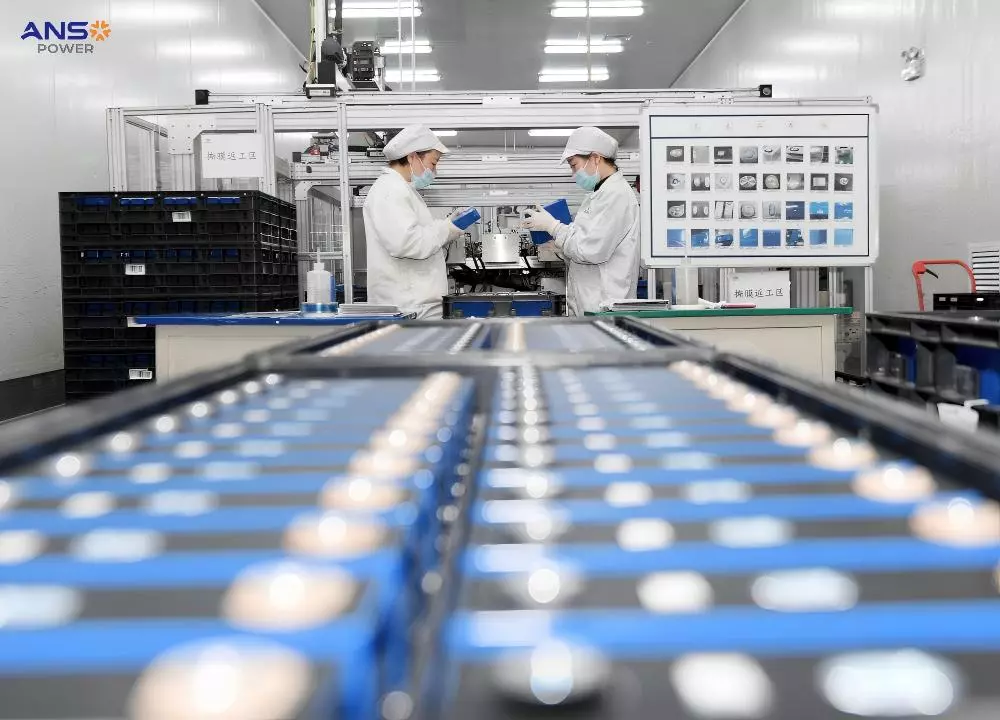
From a Battery Manufacturer’s Perspective–Bigger Is Not Always Better
In production, shifting from 314Ah to 587Ah is not a simple scale-up—it introduces real manufacturing challenges.
Larger electrodes require tighter precision to avoid coating defects, and the bigger cell core generates more internal heat during formation. The margin for error shrinks significantly, and a single quality failure in a 587Ah batch wastes more than twice the material of a 314Ah batch.
This is why the manufacturer's brand and track record matter more than the Ah number. A poorly manufactured 587Ah cell creates far greater project risk than a well-made 314Ah cell. When sourcing, look beyond the datasheet and verify:
Proven cycle life – real test data, not just theoretical specs.
Safety certifications – e.g., UL 9540A for thermal runaway.
Cell-to-cell consistency – tighter variance means better long-term string performance.
System Integration – It Takes More Than Just a Big Cell
Swapping a 587Ah cell into a 314Ah system is not plug-and-play. The higher current output and greater thermal load demand a redesigned ecosystem:
- Thermal Management: Whether the system uses air-cooling or liquid-cooling, the thermal architecture must be re-engineered for higher heat dissipation. Standard fan configurations or coolant flow rates won't suffice—inadequate cooling directly accelerates capacity degradation and shortens cycle life.
- BMS and Safety: Protection thresholds, current interruption devices, and fusing strategies must be recalibrated for the larger cell's energy potential to ensure safe operation under fault conditions.
For project buyers: When evaluating 587Ah proposals, always ask the integrator for validated thermal simulation data (specific to your chosen cooling method) and BMS test reports. A big cell works only when the entire system—cooling, controls, and structure—is purpose-built around it.
The Industry Trajectory – What Does the Future Hold?
The shift from 314Ah to 587Ah reflects a clear industry direction: fewer cells, higher energy density, and lower system cost.
But the future of ESS is not a race to the highest Ah number. The real breakthrough lies in system-level co-optimization—integrating large-format cells with smarter BMS, advanced thermal management, and standardized modular designs.
For utility-scale projects, 587Ah offers a compelling future-proof path. For smaller or highly customized projects, 314Ah remains the safer, more flexible workhorse.
Final Verdict – Which Cell Should You Choose?
Choose 314Ah for supply chain maturity, design flexibility, and proven reliability. Choose 587Ah for large-scale projects with tight land constraints—provided the manufacturer's quality data is solid.
The ultimate question is not: "Which cell has a higher Ah?"
It is: "Which cell is reliably manufactured, perfectly suited to my system architecture, and aligned with my long-term project ROI?"